
The lost wax casting process
Craftsmanship | March 2026
There is a moment within the making of every piece when form exists in its most fragile state, shaped not in metal, but in wax. It is here, in this quiet and often unseen stage of the process, that the transition from idea to object begins to take on a tangible presence, held lightly in the hand, yet carrying within it the full intention of what is to come.
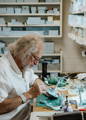
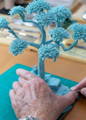
The wax model is not simply a placeholder for the final piece, but a careful translation of the original sketch, where proportion, movement and detail are considered with precision. Each surface is shaped deliberately, responding to light and touch in a way that anticipates the qualities of the metal it will eventually become. There is a sensitivity required at this stage, an understanding that every line, every contour, will be carried forward, unchanged, into the final form.
Once complete, the wax is encased within a mould, a process that both protects and conceals the work that has been done. Heat is then introduced, gradually and with control, allowing the wax to melt away and leave behind a hollow space, an absence that holds the exact memory of the form that once occupied it. It is within this space that molten silver or gold is poured, filling the void with a permanence that replaces what was once temporary.
This transformation is central to the process, where something fragile gives way to something enduring, and where the precision of the original model is preserved in a material that will outlast it. The metal cools and solidifies, taking on the full detail of the mould, capturing every subtle mark that was shaped by hand in wax. What emerges is not a reinterpretation, but a continuation, a direct translation from one state to another.
The origins of this method extend back thousands of years, used across cultures and continents in the creation of objects that were both functional and symbolic. Despite the passage of time, the process remains largely unchanged, not through resistance to innovation, but through an understanding that its integrity lies in its simplicity and effectiveness. It is a technique that requires patience, attention and a respect for each stage of its progression.
Within our workshop, this process is approached with the same care it has always demanded, allowing time for each phase to unfold without haste. There is an awareness that the success of the final piece depends not on any single moment, but on the continuity of the entire process, where each stage supports the next. The hand of the maker remains present throughout, guiding the material while allowing it to respond in its own way.
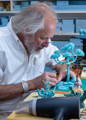
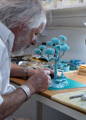
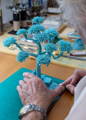
Nature informs this process in ways that are not always immediately visible, yet deeply felt. The way a surface catches light, the balance between structure and movement, the proportion of one element to another, all reflect an understanding that comes from observation rather than invention. In this sense, the process of casting becomes more than a technical act; it becomes a means of carrying forward the qualities found in the natural world into a material that can hold them.
For our family, the enduring relevance of lost wax casting lies not only in its history, but in its ability to preserve intention. It allows the original idea, shaped first in observation and then in wax, to pass through transformation without losing its integrity, ensuring that what is created remains true to its origin. This continuity between stages reflects a broader philosophy, where each step is given its due weight, and where the final object carries within it the memory of how it came to be.
Did you know?
01
The lost wax casting process dates back over 5,000 years and was used in ancient Egypt and Mesopotamia.
02
Each wax model is destroyed during casting, making every piece inherently unique.
03
The process allows for extremely fine detail to be captured in metal.
04
Molten silver is poured at temperatures exceeding 900°C.
05
Lost wax casting has been used historically for both jewellery and large-scale sculpture.
In a process defined by transformation, what remains constant is the intention carried from beginning to end, where each stage holds a quiet significance within the whole. Through this method, something transient is made permanent, not through force, but through understanding, allowing material, time and hand to work together in a way that reflects the values at the heart of our work, where craftsmanship is not only about what is made, but about how it is carried forward and allowed to endure.
Read more
The art of craftsmanship
Finishing a piece

From observation to hand-drawn sketch
Working with sterling silver and gold
The role of the hand in modern craftsmanship
Scale in craftsmanship