
Scale in craftsmanship
Craftsmanship | October 2025
In observing an animal in its natural environment, there are moments when scale shifts unexpectedly, where a small detail, such as the texture of fur or the curve of a feather, holds as much presence as the full form itself. The eye moves between these perspectives, understanding both the whole and its parts, and it is within this balance that proportion begins to take shape.
This relationship between detail and entirety carries directly into the process of making, where a piece may exist as something held lightly in the hand, or as an object that occupies space with greater physical presence. A ring, with its contained form and intimate scale, demands a precision that is immediate, where every line and surface is encountered at close range. By contrast, a larger sculptural piece, such as a 30-centimetre owl, unfolds more gradually, its form revealed through distance as well as proximity.
Despite these differences, the underlying approach remains consistent. Each piece begins with the same process of observation and translation, where proportion is established not through measurement alone, but through an understanding of how the form should sit, how it should feel, and how it should relate to its surroundings. The transition from sketch to wax, and from wax to metal, follows the same principles regardless of scale, allowing the process to remain continuous even as the outcome changes.
What shifts is the way in which these principles are applied. In smaller pieces, detail must be refined to a degree that allows clarity without excess, ensuring that the form remains legible within its limited space. Every surface is encountered directly, requiring a level of control that brings the piece into immediate resolution. In larger works, the challenge lies in maintaining cohesion across a broader form, where proportion must hold from multiple viewpoints, and where detail must support the whole without overwhelming it.
This requires an adjustment in technique, but not in intention. The hand moves differently across a larger surface, responding to weight and scale, yet remains guided by the same awareness that shapes smaller pieces. Tools may vary, and the process may extend over a longer period of time, but the principles of balance, proportion and restraint continue to define the outcome.
Nature offers a constant reference in this regard, where scale exists fluidly, from the smallest detail to the full presence of an animal within its environment. The structure of a wing, the pattern of a coat, the stance of a body, all reflect a coherence that holds regardless of size. It is this continuity that informs the way scale is approached, ensuring that each piece, whether small or large, retains a sense of completeness.


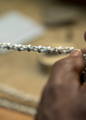
Within our workshop, this understanding allows for a range of objects to be created without losing the integrity of the process. Each piece, regardless of its size, is approached with the same level of care, ensuring that the transition from idea to object remains grounded in observation and shaped through the hand of the maker.
For our family, working across scale reflects a broader way of thinking, where the values that guide the smallest detail are equally present in the largest form. It is not the size of the piece that defines its significance, but the attention given to its making, and the continuity that connects each stage of the process.
Did you know?
01
Smaller pieces often require more precise tools to achieve fine detail.
02
Larger sculptures can take significantly longer to complete due to their scale and complexity.
03
Proportion must be carefully adjusted depending on the size of the piece.
04
The same casting techniques can be used for both small and large objects.
05
Artisans often shift their approach depending on the weight and scale of the material.
In moving between scales, the process of craftsmanship reveals its adaptability, where the same principles can be applied across different forms without losing their clarity. It is through this consistency that each piece, whether worn or placed within a space, carries a sense of connection to the others, forming part of a wider body of work that is shaped not by size, but by a shared understanding of material, form and time.
Read more
The art of craftsmanship

The role of the hand in modern craftsmanship
The lost wax casting process
Finishing a piece

From observation to hand-drawn sketch
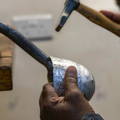
Working with sterling silver and gold