
The art of craftsmanship
Craftsmanship | April 2026
There is a quiet beginning to every Patrick Mavros piece. A moment of observation, often in the wild, where light catches on feathers or a horn, where movement becomes form. These impressions are translated into sketches by hand, the first step in a process that honours both nature and the human touch.
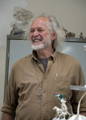
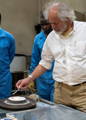
From this initial line drawing, each design enters the workshop, where time slows and craftsmanship takes precedence. Central to this process is the ancient lost wax casting method – a technique that has remained largely unchanged for millennia. A model is sculpted in wax, capturing the finest details with remarkable precision. This wax form is then encased, melted away, and replaced with molten silver or gold. What remains is a perfect translation of the original form, preserving every ridge, texture and nuance envisioned at the start.
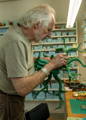
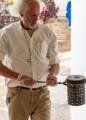
But casting is only the beginning. Once the metal has cooled, each piece is worked on entirely by hand. Filing, shaping, soldering and polishing are carried out with a level of care that cannot be replicated by machine. It is here that craftsmanship becomes deeply personal – where the artisan’s eye and instinct guide the final outcome. Whether creating a delicate ring or a 30cm sterling silver owl objet d’art, the same dedication applies. Nothing is rushed, and nothing is overlooked.
For our family, craftsmanship is not simply about technique, but about intention. It is a philosophy rooted in patience, respect for materials, and a belief in creating objects that endure. Each piece is designed to be lived with – to gather meaning over time, to be worn daily or placed within a home, quietly becoming part of a life story. These are not objects made for a moment, but for generations.
Nature remains at the heart of every creation. The natural world offers an endless source of inspiration – from the curve of a tusk to the sharpness of a quill, from the strength of an animal’s stance to the stillness of its gaze. This connection is more than aesthetic, it is a guiding principle. To observe nature closely is to understand balance, proportion and detail at its most refined – lessons that inform every piece created.
Did you know?
01
The lost wax casting method we use dates back over 5 000 years.
02
Each of our pieces begins as a hand-drawn sketch – never digitally rendered.
03
Larger sculptural pieces can take weeks, sometimes months, to finish by hand.
04
Our team studies real animal forms to ensure accuracy in every detail.
05
Each piece is entirely handmade, no mass production, ever.
In a world increasingly defined by speed, craftsmanship offers something different. It asks for time. It values skill. It honours process over immediacy. Within our workshop, these values are upheld with quiet conviction – passed down, refined, and protected, so that what emerges is more than an item of jewellery or an object for the home, but rather a legacy in silver and gold – shaped by hand, inspired by nature, and made to endure.
Read more
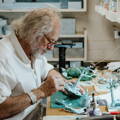
The lost wax casting process
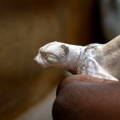
Finishing a piece

From observation to hand-drawn sketch
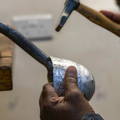
Working with sterling silver and gold

The role of the hand in modern craftsmanship
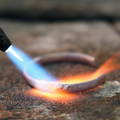
Scale in craftsmanship