
Finishing a piece
Craftsmanship | December 2025
Once the metal has cooled and the form has emerged from its casting, there is a stage in the process where the piece appears complete at first glance, yet remains unresolved in its finer detail. The surface holds the memory of its making, carrying slight irregularities and traces of the mould, and it is within this quiet transition that the work begins to shift from formation to refinement.
The piece is first examined in the hand, turned gently to catch the light from different angles, allowing subtle variations in surface and line to become visible. It is through this act of observation that the next steps are guided, not by instruction alone, but by an understanding of how the form should settle into balance. Each movement that follows is informed by this initial reading, where the eye and hand begin to work in close alignment.
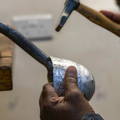
Filing becomes the first stage of this refinement, where excess material is removed with care, and edges are brought into clarity. The process is gradual, requiring a steady rhythm and a sensitivity to pressure, ensuring that the integrity of the form is maintained while allowing it to become more defined. It is not a process of alteration, but of revealing what is already present within the metal.
Soldering follows where necessary, joining elements with precision while preserving the continuity of the design. Heat is applied with control, allowing the metal to respond without distortion, and creating a bond that becomes part of the structure itself. This stage demands both technical understanding and restraint, ensuring that the connection remains seamless and unobtrusive.
As the piece progresses, polishing begins to bring the surface into its final state, moving through stages that gradually refine the texture and reflectivity of the metal. Each pass is considered, building upon the last, allowing the surface to develop a depth that responds to light rather than simply reflecting it. It is within this process that the piece begins to take on its final presence, shifting from a raw cast form into something more resolved.
Throughout these stages, the hand remains the guiding force, responding to the material as it changes, adjusting pressure and movement in ways that cannot be predetermined. Small variations begin to emerge, subtle differences in surface, in line, or in finish, that distinguish one piece from another. These are not introduced deliberately, but arise naturally through the process, reflecting the individuality of both the material and the maker.
Nature offers a quiet parallel in this regard, where surfaces are shaped over time through gradual change, and where variation exists within an underlying sense of balance. The smoothness of a worn stone, the texture of bark, the way light moves across a feather, all suggest a process of refinement that is guided by time and interaction rather than immediate completion. It is this understanding that informs the finishing of each piece, allowing it to settle into its final form without excess.
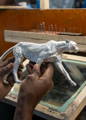


Within our workshop, this stage is where craftsmanship becomes most personal, as the decisions made are guided less by fixed measurement and more by experience and intuition. The piece is no longer defined solely by its design, but by the way it has been brought into resolution, shaped through a series of considered actions that reflect both skill and attention.
For our family, the finishing of a piece represents the point at which the process becomes fully embodied within the object, where each stage of making is carried forward into a form that is both complete and individual. It is here that the work moves beyond construction and into something more enduring, shaped not only by method, but by the presence of the hand throughout.
Did you know?
01
Filing is done by hand using a variety of tools to achieve precise edges and surfaces.
02
Soldering joins metal components using heat without melting the entire piece.
03
Polishing can involve multiple stages, each using different materials and techniques.
04
Even minor adjustments during finishing can significantly alter the final appearance.
05
No two handcrafted pieces will ever have exactly the same surface finish.
In the movement from raw cast to refined object, the piece takes on a clarity that reflects the care invested in its making, where each surface and line has been considered and resolved over time. It is within this final stage that the relationship between material and maker becomes most apparent, allowing the object to carry not only its form, but the quiet accumulation of decisions that have shaped it, ensuring that what remains is not only complete, but enduring in both presence and meaning.
Read more
The art of craftsmanship
The role of the hand in modern craftsmanship
The lost wax casting process
Working with sterling silver and gold

From observation to hand-drawn sketch

Scale in craftsmanship