
From observation to hand-drawn sketch
Craftsmanship | February 2026
At first, it is not the whole animal that holds attention, but a detail — the angle of a shoulder as weight shifts forward, the line of a spine as it curves into motion, or the way an ear turns in response to something just beyond view. These moments are often fleeting, revealed briefly before dissolving back into the wider landscape, yet they carry within them a clarity that remains long after the encounter has passed.
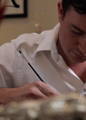
To observe in this way requires more than looking. It asks for stillness, for time spent returning to the same subject under different conditions, allowing understanding to build gradually. Form is not fixed, but constantly adjusting, shaped by movement, by light, and by the environment in which the animal exists. Over time, these observations begin to settle into something more cohesive, not as a complete image, but as a series of impressions that together define structure, balance and presence.
The transition from this experience to paper is neither immediate nor literal. The hand begins to move with restraint, guided by memory as much as by sight, allowing lines to emerge that are selective rather than exhaustive. What is drawn is not every detail, but the essential framework that holds the form together, where proportion and movement are given precedence over surface complexity.
There is a discipline within this reduction. Each line must hold its place, contributing to the whole without excess, creating a composition that feels resolved without becoming rigid. The drawing develops through adjustment, with marks refined or removed as the form becomes clearer, allowing the character of the animal to emerge through a process that is both deliberate and responsive.
Working by hand maintains a continuity between observation and expression that remains difficult to replicate through digital means. The movement of the pencil across paper carries a direct connection to the way the subject has been understood, allowing for subtle shifts in pressure and direction that reflect both structure and feeling. This introduces a quiet variability into the drawing, ensuring that it retains a sense of life rather than becoming overly fixed.
In contrast, digital rendering often prioritises precision at the expense of this connection, creating an image that is complete in appearance, yet removed from the process through which understanding is developed. By drawing by hand, the relationship between seeing and making remains intact, allowing each stage to inform the next without interruption.
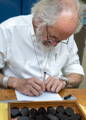
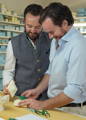
Within our process, the sketch becomes the point at which observation is given form, providing a foundation that guides the transition into wax and, ultimately, into metal. The clarity established at this stage ensures that the piece retains its balance as it moves through each phase, allowing the original intention to remain present within the final object.
Nature continues to inform this process in ways that extend beyond the visible, shaping an understanding of proportion, movement and restraint that carries through every stage of making. What is learned through observation becomes embedded within the drawing, and from there into the piece itself, creating a continuity that is both subtle and essential.
For our family, drawing by hand is not simply a method, but a way of remaining connected to the origin of each piece, ensuring that the act of making begins with understanding rather than assumption. It reflects a commitment to process that values time and attention, allowing each object to carry with it the memory of how it was first seen and interpreted.
Did you know?
01
Artists often study animal anatomy through repeated observation rather than relying on reference images alone.
02
Hand-drawn sketches allow for continuous refinement as understanding of the subject deepens.
03
Subtle variations in line weight can suggest movement, depth and structure within a drawing.
04
Many traditional craftsmen consider drawing an essential skill for developing proportion and form.
05
Sketching by hand creates a direct connection between observation and final design.
In the movement from observation to line, something more than form is carried forward, as the drawing becomes a record of attention, shaped by time and guided by understanding. It is this continuity that allows the final piece to hold a sense of origin within it, ensuring that what emerges is not only an object, but a reflection of a process that remains grounded in the natural world, and in the quiet discipline of seeing before making.
Read more
The art of craftsmanship
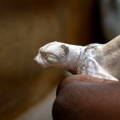
Finishing a piece
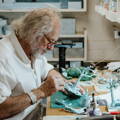
The lost wax casting process
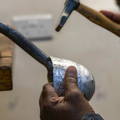
Working with sterling silver and gold
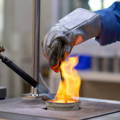
The role of the hand in modern craftsmanship
Scale in craftsmanship